Flight and transcendence
The Master Butchers Singing ClubFlight and transcendence in the novel move from Franz Waldvogel’s wordless bodily fascination with airplanes to a shared, defiant journey that lets his dying mother, Eva Waldvogel, imagine human life as part of a design larger than illness and death. The plane does not cure her or erase her pain; its force lies in the heightened perception it gives her, and in the convictions she voices after returning to earth.
Franz’s fascination with flight
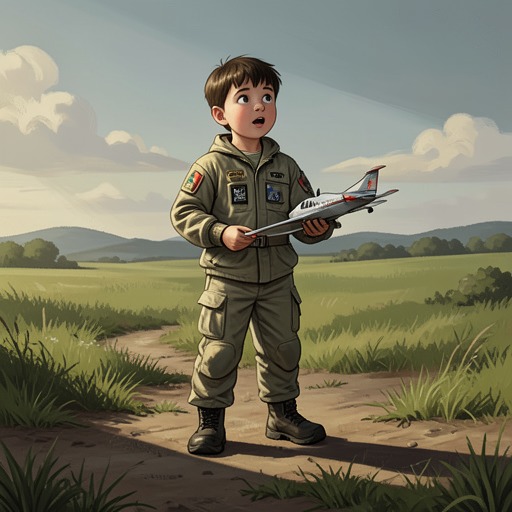
Pouty Mannheim’s war-surplus Jenny makes flight tangible to Franz. Pouty keeps the aircraft near the butcher shop, working on its engine and practicing rolls, dives, and elaborate turns. With Fidelis Waldvogel’s permission, he lands in the flat field behind the house. Whenever Pouty visits, Franz hurries out of the shop, studies the cockpit controls and the official-looking flight log, and eagerly plays at being ground crew, turning the propeller and calling for everyone to stand clear.
The moment that grips Franz is not a stunt in the air but the instant the wheels leave the ground. He runs after the plane, shouts, and throws his cap as it rises. The widening space between earth and aircraft brings on a release so physical and intense that he can scarcely understand or describe it. Once the plane is gone, he stands still, quietly collecting himself before facing anyone else. Flight unsettles his reserved composure, then leaves him needing to regain it.
Eva is the one person Franz believes might understand this experience. He talks with her at length about aircraft and their differences, drawing on newspapers and magazines he has collected. His bedroom walls and scrapbook preserve that enthusiasm: photographs of aviators, aircraft pictures, handbills, a copied poem, and his own drawings and models. This private archive makes the airplane more than a passing spectacle. It gives Franz a language of details and images for an excitement he cannot otherwise explain, and it creates a subject he and his ill mother can share.
A flight imagined as a gift
The idea of taking Eva into the air begins in conversation. When she asks what it is like above the clouds, Franz answers with an image of being able to step onto them and bounce. Her skeptical look carries pride in his invention. At that moment, he decides that he must take her flying. The thought quickly becomes an urgent commitment: he sees the ride as something that simply has to happen, and as a noble duty toward his mother.
The plan means defying a clear boundary. Fidelis has forbidden Pouty to take Franz up, but Franz judges this journey different because Eva is sick and the ride is for her. He goes to Pouty without waiting for a convenient opportunity, borrowing Mazarine Shimek’s bicycle to reach the barn where the plane is kept. His urgency shows in his raised voice, moving hands, pleading, and persistence. Pouty initially points to Eva’s illness as a reason against the flight; Franz’s manner eventually persuades him to agree, despite the danger of going against Fidelis’s order.
On the morning of Fidelis’s deliveries, Pouty lands the plane behind the shop. Franz finds Eva awake and dressed for the ride in a white housedress patterned with roses. Her hair has been damaged by treatment, and her thin face and careful preparations make the effort of getting ready visible. She still takes pains to be clean and presentable. Franz enters her room, steadies himself, touches her arm, and tells her that her plane has arrived. The announcement turns his imagined gift into a real departure.
The journey above Argus
Once airborne, Franz holds Eva around the waist as the Jenny climbs. The first ascent seems steep enough to make them forget to breathe. Pouty levels the plane and heads west, then follows the river, hoping to show Eva birds of prey. From above, the river becomes a gleaming gray curve and then a thin, mercury-like line; trees appear as dusty green puffs, roads as dark threads, and the drought-sick fields spread beneath them. The plane bounces on hot air, follows the river’s bends, circles an oxbow, and swoops low over a farm where Pouty knows the people.
Franz’s purpose is inseparable from the sensation of flight. He imagines that the wind scouring their faces will make them smooth and pure, and he hopes the experience will bring Eva relief. Pouty, too, invests the ride with an almost miraculous promise, imagining that it might even cure her. Their hopes are not borne out in a literal sense. Eva’s pain does not disappear; she later says it grew more intense. But the mental joy grows with it. Flight gives her an experience powerful enough to make pain and exhilaration coexist rather than cancel one another.
The plane’s return to earth does not end the journey’s significance. Franz carries Eva back to bed, where she rests propped on pillows, drinking water and shuddering with happiness and pain. She tells Delphine Watzka that her brain seemed to be gulping new air in the sky and that she was thinking with unusual speed and intensity. The ride has altered how she sees her surroundings: Argus, from above, was only a spot, and its people were spots within that spot. Yet these tiny lives were flying by their own power, not simply being blown about by the wind.
Eva’s larger design
Eva’s vision widens from the view below the airplane to the idea of a plan greater than familiar religious rules. She tells Delphine that this larger idea exceeds church candles, confessionals, and the Sacred Host. She does not claim to know what the plan is; she insists instead on its scale, greater than the rules that ordinarily frame belief. Afterward, she calls her sons to her room and makes the point again: religious practices may matter to them, but they are not the limit of what exists.
Her gesture gives the vision its most intimate measure. Eva raises her pinkie and says that the plan accounts both for the huge thing and for the little fingernail. The contrast joins the aerial perspective, where people shrink to specks, to the particular body that remains precious and vulnerable. The plan is vast enough to contain what the eye sees from above, but also fine-grained enough to include the smallest part of a person.
Eva applies this belief directly to her approaching death. She asks her sons not to take it too hard if she dies, because death belongs to things larger than they can imagine. Human brains, she says, are only beginning to learn the greatness that makes achievements such as flying possible. She imagines herself as part of a continuing pattern: she will remain made of things, and things will continue to be made of her. The flight therefore does not offer escape from mortality; it changes the frame in which mortality can be understood.
Limits and significance
The scene preserves a tension between the promise of flight and its limits. Pouty’s belief that the ride could cure Eva is an excess of hope, and Franz’s wish to give her joy cannot reverse her illness. Even Eva’s pleasure is accompanied by stronger pain. The novel nevertheless presents the flight as consequential: it grants her a new vantage on Argus and a language for the reassurance she wants to pass to her children. Its transcendence is neither a supernatural event nor a medical cure, but a change in scale and understanding rooted in a physical experience.
Flight also binds mother and son through the very sensation that had previously set Franz apart. He has chased the Jenny alone, unable to name what its ascent does to him; now he holds Eva as they rise together. His private exhilaration becomes an act of care, while Eva’s response extends it into a meditation on human agency, religious certainty, and belonging within a material world. The sky offers no proof of the larger design she perceives. It gives her a moment in which ordinary ground, bodily pain, and the fear of death can be seen as parts of something wider.